
A luxury client is not comparing prices. They are comparing taste. When someone with a seven-figure renovation budget lands on your site, they are asking a single question: does this studio operate at my level?
Luxury interior design website development exists to answer that question in seconds, then quietly guide a qualified inquiry into your inbox.
Hire Our Professional Services
What Separates a Luxury Interior Design Website Development
Plenty of interior design websites are attractive. Very few feel expensive. The difference usually comes down to restraint, pacing, and craft.
A high end interior design website shows fewer projects, not more. It uses larger images with more space around them. It loads smoothly, moves slowly, and never shouts. Where a mid-market site stacks six calls to action, a luxury site places one, confidently.
Think of it like a private showroom versus a showroom floor. Both sell furniture. Only one makes you lower your voice when you walk in.
Editorial Structure: Borrow From Magazines, Not Marketplaces
The most convincing luxury sites follow an editorial interior design website model. Each project is treated as a feature story rather than a gallery dump.
An editorial project page typically opens with a single full-width image, followed by a short narrative introducing the client brief and the constraints, then a sequence of images paced with white space, pull quotes or material notes between sections, and finally a quiet closing detail shot.
This structure works because luxury clients are buying judgment. They want to understand how you think, not just what you chose.
Black and White, Dark Modes, and Elegant Palettes
Palette choices carry enormous weight at this level.
An interior design website black and white treatment is a reliable luxury signal. Monochrome typography and interface elements let the photography supply all the color, creating instant contrast and sophistication.
An interior design website dark theme works beautifully for studios whose work leans toward dramatic, moody, or evening-lit interiors. Deep charcoal backgrounds make warm interior photography glow. Dark themes demand discipline, however: type must remain readable, and images need consistent exposure or the page looks uneven.
An elegant interior design website may also use warm off-whites, soft stone tones, and a single metallic accent. The rule is the same in every direction: limit the palette severely and let materiality do the talking.
Typography as a Luxury Signal
Nothing cheapens a premium site faster than the wrong typeface. High-end studios typically pair a refined serif for headlines with a quiet sans-serif for body text, set at generous sizes with wide line spacing.
Letter spacing on navigation and small caps for section labels add a couture feel. Avoid more than two families, avoid heavy weights, and never use decorative script for anything a client must actually read.
Hire Our Professional Services
Luxury Interior Design Website UI Details
Luxury interior design website UI is defined by what happens between clicks. Slow image fades, cursor-following captions, smooth scroll, and gentle hover states create the sense of a considered environment.
Good interior design website animation at this level is almost invisible. Images reveal rather than slide in. Menus expand rather than drop. Nothing bounces.
These details require careful front-end work, because poorly implemented motion feels cheap immediately. If you want this level of execution, you can hire a front-end web developer to build the interactions properly.
Building the Portfolio Page
Your luxury interior design portfolio website lives or dies on its project index. Present work as a grid of large, uniform images with minimal labels, or as a vertical sequence of full-width features.
Show six to ten projects maximum. A long list suggests volume; a short list suggests selection.
Each interior design website project page should include the location, project scope, and a short paragraph of context. Resist the urge to list every supplier and product unless your audience specifically values that detail.
Trust Without Noise
Luxury clients still need reassurance, but the delivery must be subtle.
Interior design website testimonials work best as short pull quotes set in large type, attributed simply, perhaps by first name and city. Three well-chosen quotes outperform fifteen.
Press mentions belong as small logos in a quiet row, not as a flashing badge. Awards get a single line. Your credibility should feel assumed rather than argued. also check interior design website development.
The Inquiry Experience
High-value inquiries deserve a considered form. Ask for name, email, project location, project type, and timeline. A budget range field is optional but genuinely useful for filtering.
Set expectations clearly with a line such as “We take on a limited number of projects each year and respond within two business days.” That single sentence communicates exclusivity and professionalism at once.
Avoid live chat widgets, pop-ups, and discount language. They belong to a different market.
Photography Standards
No amount of development can rescue weak photography on a luxury site. Commission a professional interior photographer, shoot in consistent light, and edit with a uniform profile across all projects.
Technically, deliver images at high resolution but serve compressed modern formats so pages stay fast. A slow-loading luxury site undermines the impression instantly.
Performance and Search Visibility
Premium does not mean invisible. High-net-worth clients search too, often for terms like “luxury interior designer [city]” or “high end residential design [region].”
Give each project page unique metadata, use descriptive alt text, and build one or two well-written service pages. Keep the code lean so image-heavy pages still load quickly.
Launching Your High-End Site
A luxury site launch works best in stages: finalize photography and copy, build and test the structure, review the site on multiple devices, then publish with your strongest project featured first.
Plan to refresh the homepage hero whenever you complete a project that raises your standard.
Final Thought
Luxury interior design website development is an exercise in subtraction. Fewer projects, fewer words, fewer colors, fewer buttons, executed flawlessly.
If you want a developer who can hold that standard through every detail, explore the full service list at talha_jamil on Fiverr and start building a portfolio worthy of your best work.
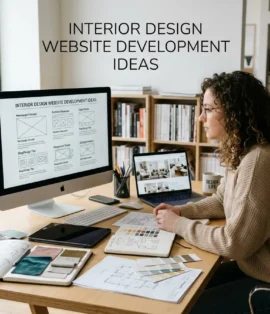
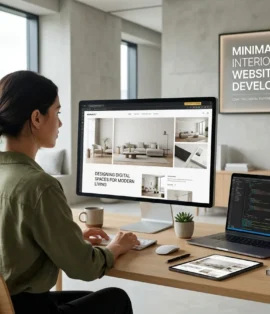
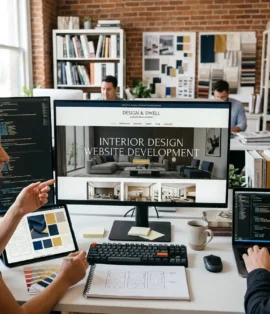
Minimalist Interior Design Website Development: Clean Layouts, Fonts & White Space - DreamNexTech
[…] Serif headlines suggest heritage and craft. Geometric sans-serifs suggest modernity and precision. Humanist sans-serifs sit comfortably between the two. check out luxury interior design website development. […]