
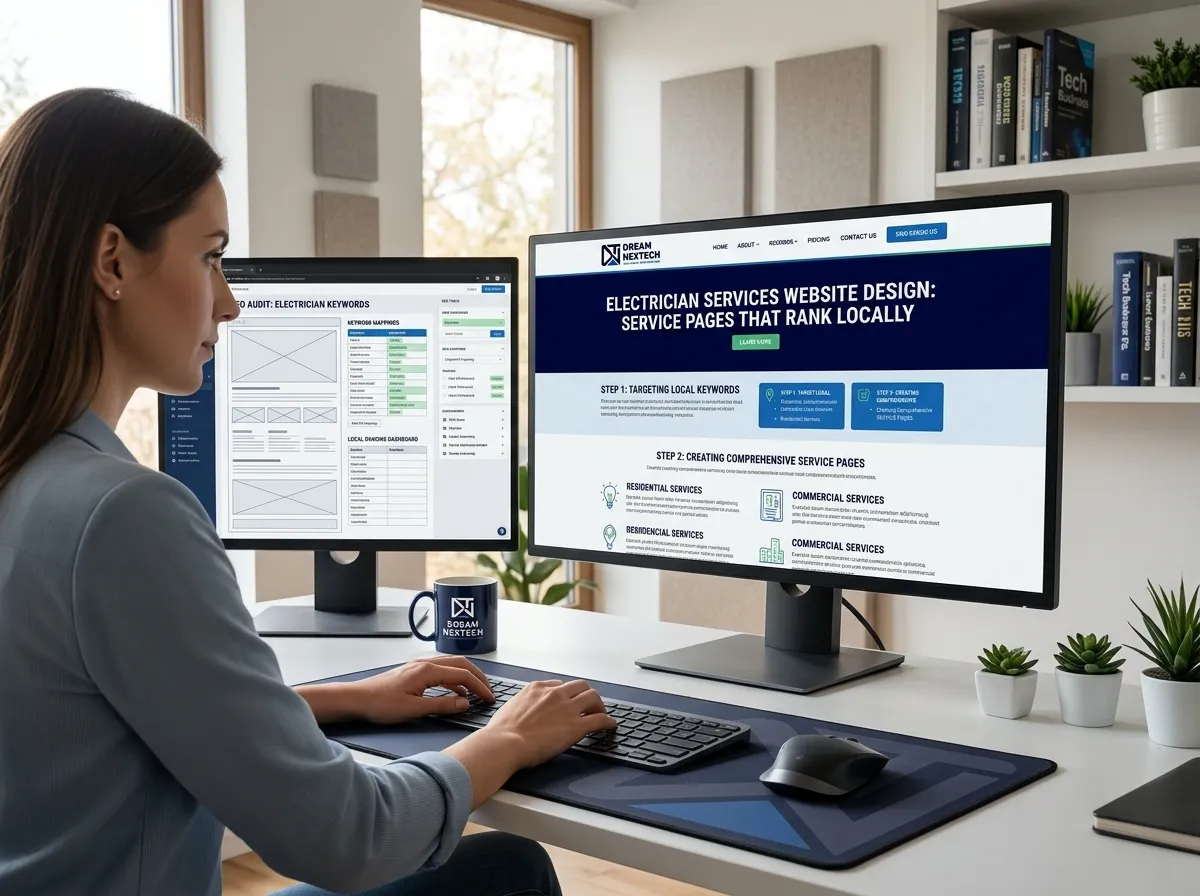
Nobody searches “electrician services.” They search “fuse board replacement cost Leeds, “landlord EICR certificate near me,” and “who can install an EV charger in Bristol.”
Which means the single most common structure on electrician websites one page called Services with a bullet list of twelve things you do — is competing for a term nobody types, while ranking for none of the ones they do.
Fixing that is usually the highest-return change we make to an electrician’s website. Here’s how it works.
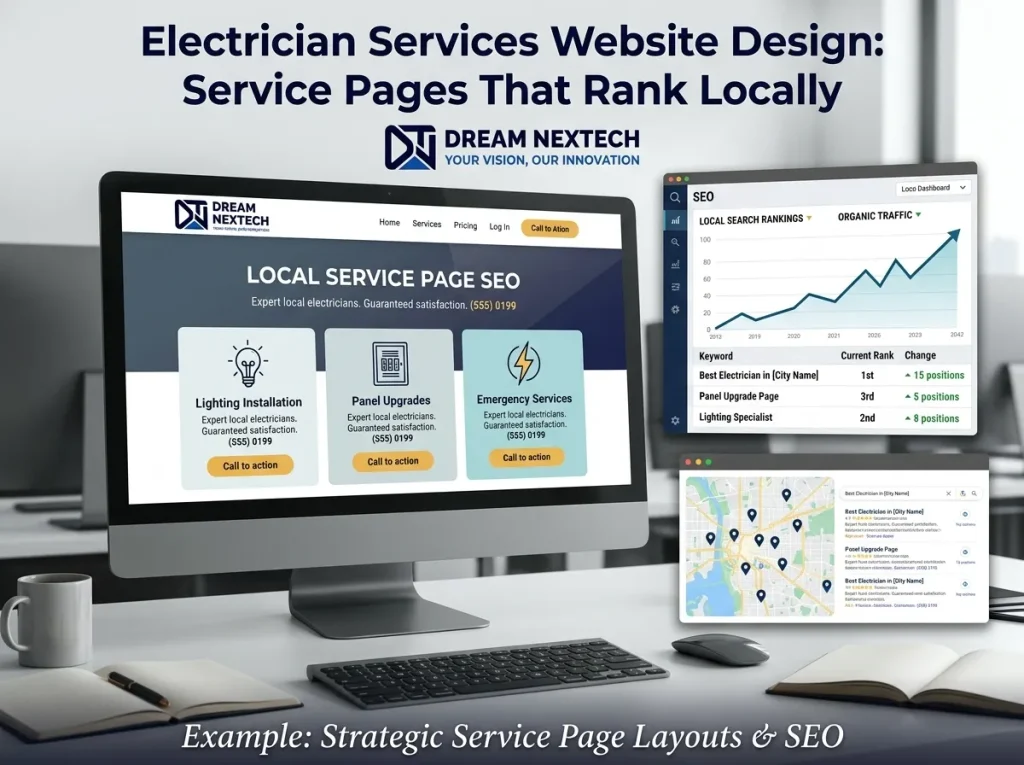
Electrician Services Website Design
Why One Services Page Can’t Rank for Twelve Services
Google ranks pages, not businesses. A page can rank well for one topic and its close variants. It cannot rank simultaneously for rewires, EICR testing, EV chargers, fuse boards, fault finding, and outdoor lighting, because a page about everything is a page about nothing.
Your competitor with six separate service pages has six chances to appear in local results. You have one, and it’s diluted.
The fix is structural rather than clever: one page per service, each written properly, each interlinked, each carrying its own local signals.
The Service Pages We Build for Electricians
The right set depends on your work, but a typical domestic-focused electrician website gets:
- Full and partial rewires
- Consumer unit and fuse board replacement
- EICR and landlord electrical safety certificates
- EV charger installation
- Fault finding and repairs
- Outdoor, garden, and security lighting
- Socket and lighting installation
- PAT testing
- Emergency callouts
Contractors doing commercial work add planned maintenance, emergency lighting testing, fire alarm systems, three-phase work, and fit-outs. If that’s you, our guide to electrician company website development covers how to structure both audiences without one drowning out the other.
Nine to twelve service pages is normal. Each one is a separate entry point from search.
What Goes On a Service Page That Converts
A service page that ranks and converts follows a consistent shape:
A clear H1 naming the service and the area. “Fuse Board Replacement in Leeds and Wakefield.”
An opening paragraph answering the actual question. Usually “do I need this, and what will it cost?” Get to it in the first three sentences.
What the job involves. Plain language, no jargon. What you’ll do, what needs to be isolated, whether they need to be home.
How long it takes. “Most consumer unit swaps are a single day.” People are planning around it.
Pricing guidance. Not a fixed price list — a range and the factors that move it. “Most run £450–£700 depending on board size and circuit count.” This filters time-wasters and reassures serious enquiries. Pages that include it consistently convert better than pages that don’t.
Signs you need it. For fuse boards: no RCD protection, rewireable fuses, frequent tripping. This section captures people who don’t yet know what they’re searching for.
Compliance detail. Part P notification, certification issued, building control sign-off. Reassuring and genuinely useful.
Three or four photos of that exact job. Not generic images — actual boards you’ve replaced.
Two or three relevant reviews. Filtered to this service where possible.
A clear call to action. Tappable phone number and a four-field quote form. On mobile, a sticky call bar throughout.
Links to related services. Someone reading about EICRs may need a fuse board upgrade.
Aim for 800–1,200 words per page. Enough to be genuinely useful; not so much that nobody reads it.
Layering in Local
Service pages get you halfway. Local intent gets you the rest.
Name your towns naturally in the copy. Not stuffed — mentioned where it makes sense. “We cover Leeds, Wakefield, and Harrogate for consumer unit work.”
Build area pages as well as service pages. One page per town, each with real local content: the areas you cover, typical housing stock, response times, recent jobs there. Not the same paragraph with the place name swapped — Google detects that, and so do readers.
Interlink the two sets. Service pages link to area pages and back. For your biggest service in your biggest town, a combined page — “EV Charger Installation in Bristol” — often outranks both.
Add schema to every service page. Service markup with the area served, plus Electrician markup sitewide with your hours and contact details.
Keep your name, address and phone identical everywhere. Your site, Google Business Profile, and every directory. Inconsistent formatting quietly damages local rankings and it’s one of the most common problems we find.
Cite specifics. Recent jobs with towns named, local landmarks where relevant, area-specific pricing notes. Specificity is what separates a real local page from a templated one.
also check electrician website design ideas.
The Technical Side
Ranking work is wasted if the page is slow. Every service page we build meets the same standard:
- Largest Contentful Paint under 2.5 seconds on a mid-range phone over 4G
- Hand-coded semantic HTML with a proper heading hierarchy
- Images in WebP and AVIF, sized per viewport with
srcset - Fonts subset and preloaded to eliminate layout shift
- Tappable phone number in the header on every page, plus a sticky mobile call bar
- Responsive from 320px upward, tested on real devices
Examples of our finished builds are in our development portfolio.
Built as Templates, Not One-Offs
Nine to twelve service pages sounds like a lot of work. Built properly, it isn’t — because they’re a reusable page template, not twelve bespoke designs.
We build one service page type with defined content blocks, then populate it. The tenth page costs almost nothing to add, and your office manager can create new ones as you take on new work. Adding “battery storage installation” next year should take twenty minutes, not a developer invoice.
That’s also true of area pages, which is what makes covering eight towns realistic rather than theoretical.
If you already have a designer and just need the pages built out properly, we also work purely as front-end developers on existing designs.
What This Typically Produces
The pattern we see when an electrician goes from one services page to a proper structure: rankings appear for terms they never previously showed up for, traffic becomes more qualified because people land on the exact service they searched for, and enquiries rise disproportionately to traffic — because someone arriving on a fuse board page from a fuse board search is already most of the way to calling.
It takes two to three months to show properly in search. It’s slower than paid ads and considerably cheaper over any reasonable timeframe.
Get Your Service Pages Built
If your website has one page listing everything you do, you’re competing for a search term nobody uses.
Ask DreamNexTech for a free structure review. Send us your URL and we’ll map out which service and area pages you’re missing, what your competitors rank for that you don’t, and a fixed quote to build them.
Website design and development runs alongside the SEO and digital marketing services we offer — and on service page structure, the two are genuinely the same job.
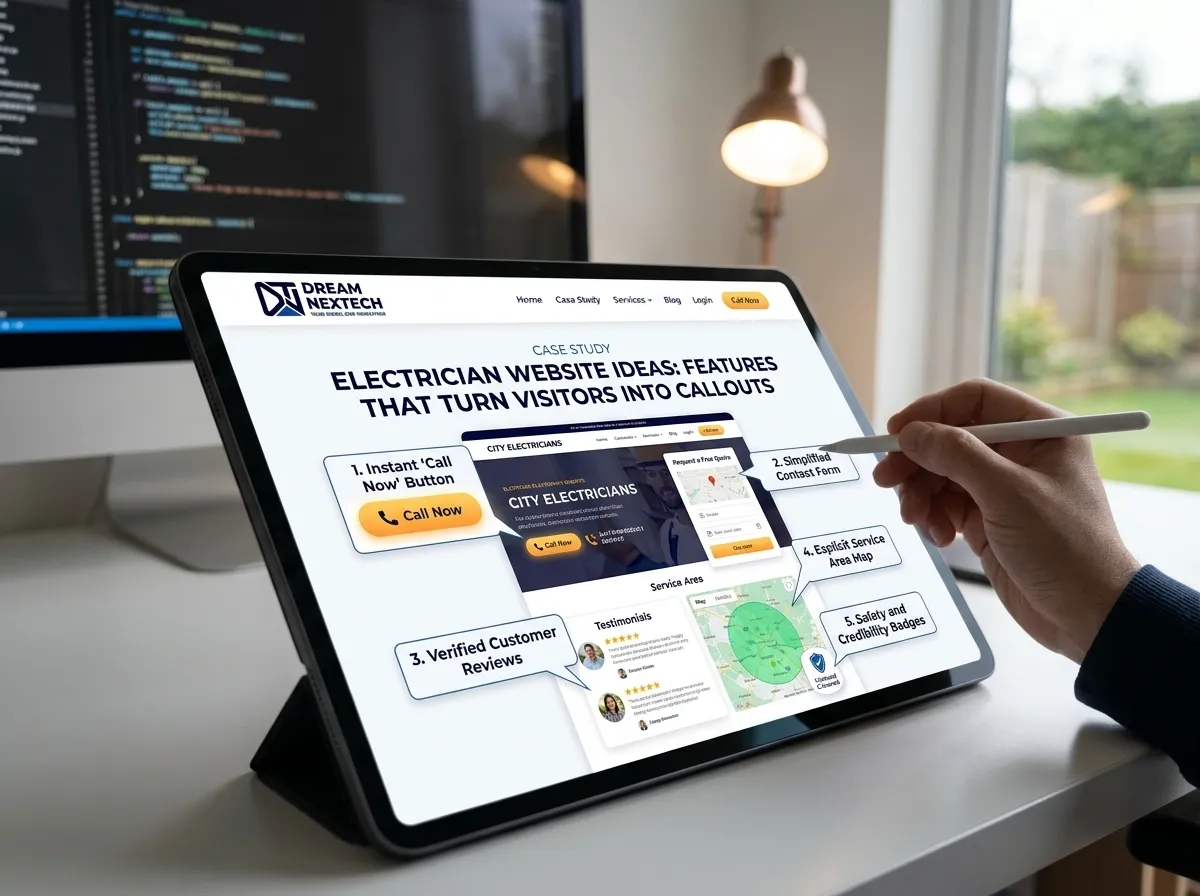
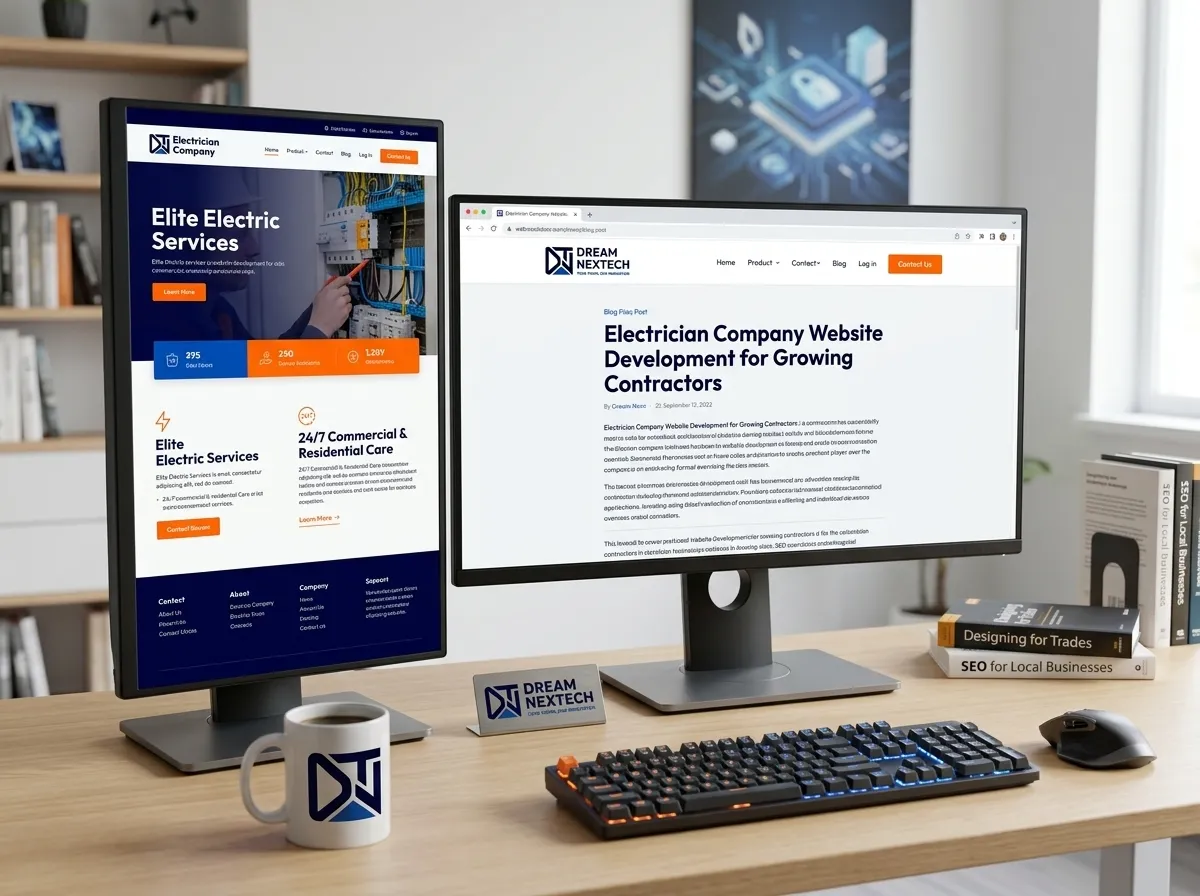



Electrician Company Website Development For Growing Contractors - DreamNexTech
[…] also check Electrician Services Website Design. […]