
There are two ways to waste a website budget.
The first is a beautiful site nobody finds — page four of Google, invisible in the map pack, generating traffic only from people who already knew your name.
The second is a site that ranks well and converts nobody — hundreds of visitors a month, a handful of calls, and a booking form that quietly fails.
Eye clinic website design that ranks and converts solves both problems in the same build, because they are not separate disciplines. They are two halves of one system.

Eye Clinic Website Design That Ranks and Converts
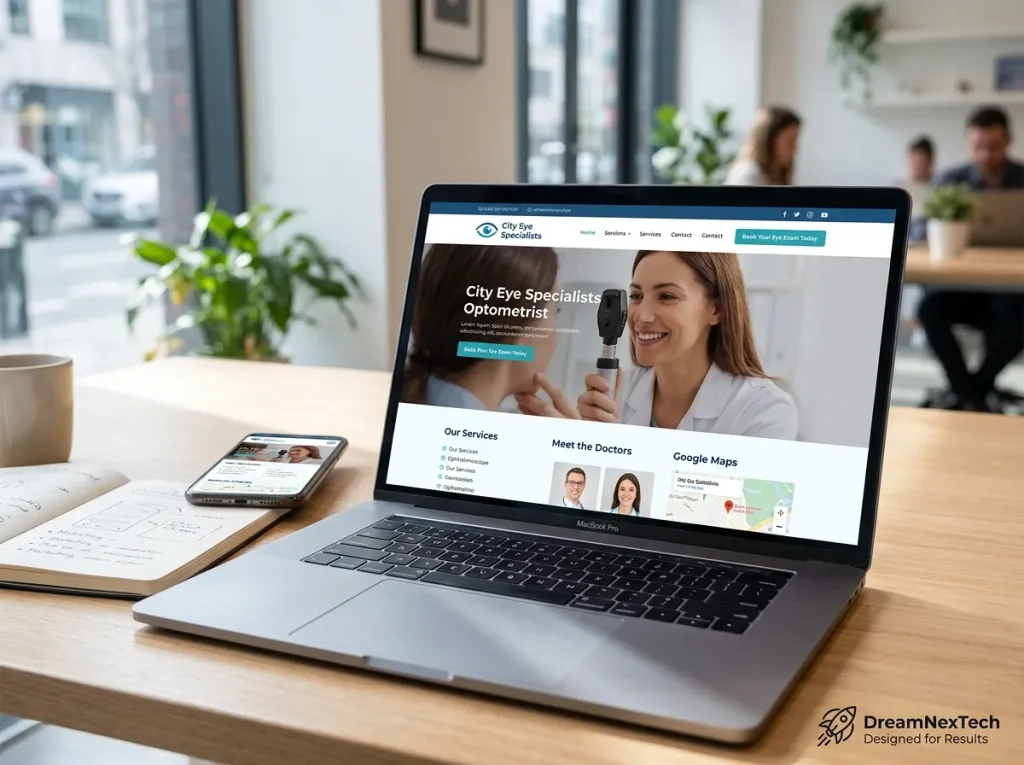
check out for Eye Clinic Website Design That Ranks and Converts below:
Why Ranking and Converting Must Be Designed Together
SEO agencies optimise for traffic. Designers optimise for appearance. Neither is measured on booked appointments, so neither owns the outcome.
The result is predictable. The SEO team adds 2,000 words of keyword-stuffed copy that buries the booking button. The design team removes it because it looks cluttered. Rankings drop. Everyone blames everyone.
When one team owns both, the tension resolves. Content is structured to rank and to guide. Page speed serves both Core Web Vitals and conversion. Clear architecture helps crawlers and patients simultaneously.
also check our Coffee Shop Website Design Services.
The Ranking Half: Getting Found in Local Search
Eye care is dominated by local intent. Almost nobody searches for an optometrist in another city. That makes local SEO the single highest-leverage channel for your practice.
Technical foundations. Fast load times, mobile-first indexing readiness, secure HTTPS, clean crawlable structure, XML sitemaps, and no orphaned pages.
Structured data. MedicalClinic, LocalBusiness, and Physician schema so search engines understand your services, locations, hours, and practitioners precisely.
Service page architecture. One page per service, each targeting a real keyword cluster — comprehensive eye exams, contact lens fittings, dry eye treatment, myopia management, glaucoma care, cataract evaluation, diabetic eye exams, emergency eye care.
Location pages. Genuinely distinct pages for each area you serve, with unique content, local landmarks, directions, and area-specific information. Never duplicated boilerplate with the city name swapped out.
Google Business Profile alignment. Consistent NAP across the site and every directory, categories set correctly, and a review generation flow built into your patient journey.
Content that answers real queries. Blog and FAQ content targeting the questions patients type before they book: how often should I get an eye exam, why are my eyes always dry, is my child’s screen time damaging their vision, does insurance cover contact lenses.
Authority signals. Local citations, professional directory listings, community involvement, and earned links from relevant local sources.
The Converting Half: Turning Rankings Into Appointments
Traffic is a vanity metric. Booked chairs are the business.
One dominant action per page. The booking CTA is the highest-contrast element on every screen. Everything else is secondary.
A short form. Name, phone, service, preferred time. Every additional field costs completions.
Persistent mobile actions. A sticky Call and Book bar on every page, always within thumb reach.
Trust at the decision point. Live Google reviews, credentials, insurance logos, and years in the community placed directly beside conversion elements.
Objection handling on the page. Insurance accepted, cost ranges, appointment duration, parking, dilation, availability. Every unanswered question is an exit.
Service pages that function as landing pages. A visitor arriving from a dry eye search should be able to read, trust, and book without navigating anywhere else.
Speed. A page that loads in two seconds converts substantially better than the same page at five. Performance is a conversion feature, not a technical footnote.
Our team’s responsive design and development work demonstrates the build quality that makes both halves possible.

Measurement: The Part Most Agencies Skip
If you cannot attribute bookings to pages, you are optimising blind.
We configure full tracking from day one: organic sessions by landing page, keyword position tracking for every target term, booking form submissions as conversion events, click-to-call and direction-request tracking, form abandonment analysis, and heatmaps on high-traffic pages.
You receive a monthly report tying rankings to traffic to booked appointments — the only chain that matters.
A Realistic Timeline
Honest expectations prevent disappointment.
Weeks 1–8: design and build. Conversion improvements begin the day you launch, because better UX affects the traffic you already have.
Months 2–4: technical SEO gains take hold. Indexing improves, speed gains register, and long-tail terms begin ranking.
Months 4–8: competitive local terms move. Map pack visibility improves as reviews, citations, and content authority compound.
Months 8+: sustained growth. Content and authority accumulate, and the cost per acquired patient continues falling.
Anyone promising page-one rankings for competitive terms in thirty days is selling you something they cannot deliver.
Why DreamNexTech Delivers Both
We are a digital marketing agency that builds websites, not a web shop that dabbles in marketing. Design, development, SEO, content, and conversion optimization sit with one team, accountable to one number: booked patients.
That means no handoff gaps, no conflicting priorities, and no vendor blaming another vendor when results stall. Assess the work yourself in our developer’s full project portfolio.
Get the Audit That Shows You the Gap
Most practice owners have never seen a side-by-side of their site against the three competitors outranking them. It is usually the most clarifying thirty minutes they spend on marketing all year.
Request your free ranking and conversion audit from DreamNexTech. We’ll show you where you rank, who is beating you, exactly where your site loses visitors, and what it would take to fix both — with a fixed-scope proposal and no obligation.