There’s a brutal truth about selling home decor online: your competitor’s cushions aren’t better than yours. Their website just makes people believe they are.
Decor is a taste-driven purchase. Buyers aren’t comparing spec sheets — they’re deciding whether your brand has taste they trust. That judgement happens in seconds, entirely through design. This guide walks through everything that goes into a Home Decor Website Design Service that actually sells in 2026: structure, layout, visuals, performance, and the conversion details most stores skip.
Hire Our Professional Services
Home Decor Website Design Service
Step 1: Decide What Your Site Is Actually For
Three very different sites get called “home decor websites”:
Ecommerce store — selling physical products. Priority: product pages, filtering, checkout speed.
Interior design studio — selling services. Priority: portfolio, case studies, enquiry flow.
Decor blog or affiliate site — selling attention. Priority: content architecture, internal linking, page speed.
Build for the wrong one and every later decision is slightly off. Pick first, design second.
Step 2: Site Structure and Navigation
Home decor shoppers navigate by room before anything else. Structure your main menu accordingly:
Shop by Room → Living Room, Bedroom, Dining, Kitchen, Bathroom, Outdoor Shop by Category → Lighting, Textiles, Wall Art, Storage, Mirrors, Rugs Shop by Style → Modern, Minimal, Vintage, Boho, Scandinavian, Farmhouse Collections / New In / Sale Journal / Inspiration About / Contact
Keep the top level to six items or fewer. Use a mega menu with small category thumbnails — decor buyers respond to images in navigation far more than text links.
Every category needs a real landing page with an intro paragraph, not just a bare product grid. That paragraph is what ranks. chrck out home decor website theme.
Step 3: Homepage Layout That Converts
A homepage isn’t a brochure. It’s a routing system. The layout that consistently performs:
- Hero — one full-bleed styled room photo, one headline, one button. No carousel.
- Shop by room tiles — three to six image tiles, the most-clicked block on most decor homepages.
- Featured collection — six to eight bestsellers with clear prices.
- Brand story strip — two sentences plus one photo. Materials, craft, sourcing.
- Shoppable room scene — hotspot-tagged lifestyle image.
- Social proof — reviews, press logos, or user photos.
- Trust bar — shipping, returns, guarantees, secure payment.
- Newsletter capture — with a genuine reason to sign up.
Notice what’s missing: pop-ups on arrival, autoplaying video with sound, and animated sliders. All three measurably increase bounce.
Step 4: Colour, Typography, and Visual System
Your home decor website colour palette should follow the 60-30-10 rule: 60% neutral base, 30% secondary tone, 10% accent for buttons and highlights.
Palettes performing well in 2026:
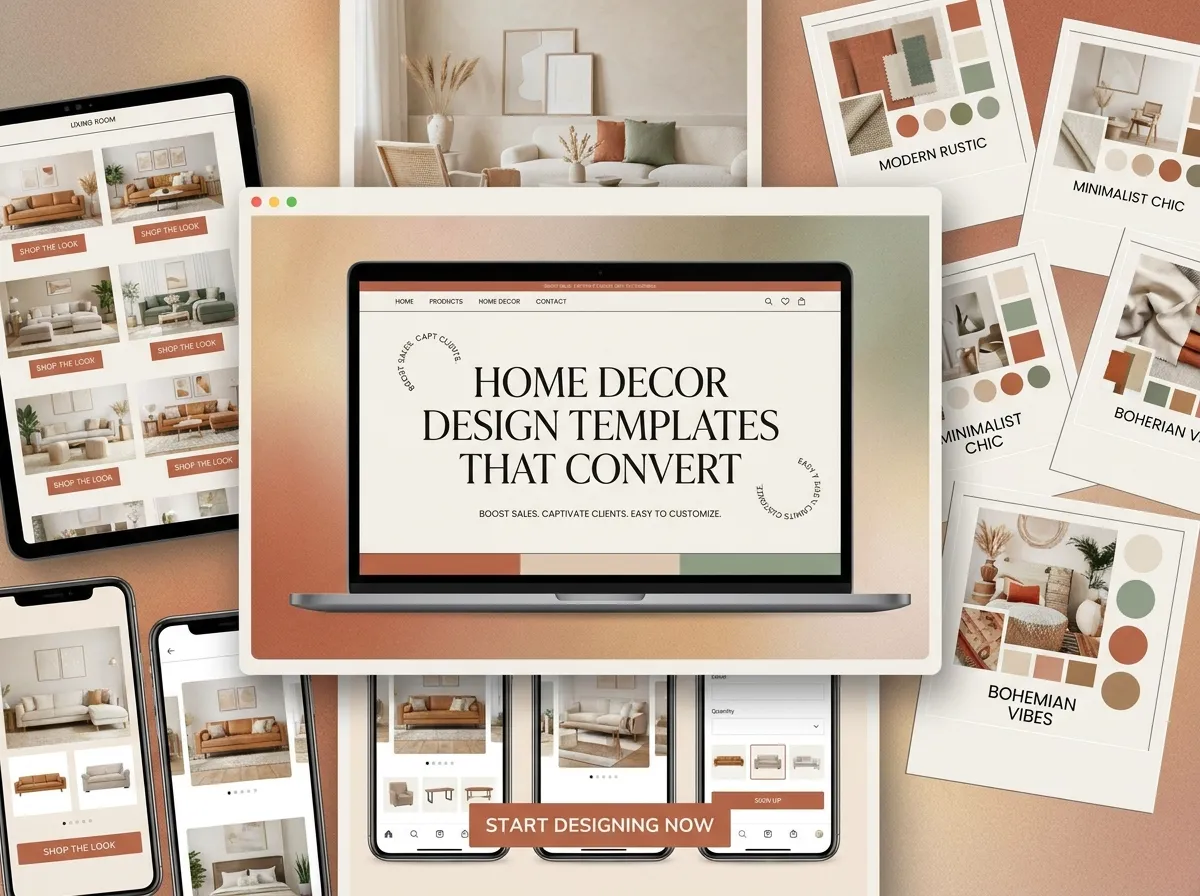
- Warm minimal — bone, oat, soft black, terracotta accent
- Sage modern — off-white, muted sage, warm brass
- Luxe dark — charcoal, ivory, antique gold
- Coastal — sand, chalk white, muted denim blue
For typography, pair one serif with one sans-serif, and stop there. Body text at 16–18px minimum with generous line height. Buttons in the sans, always — decorative type on a CTA reduces clicks.
Step 5: Photography Standards
Photography is not a design detail here. It is the design.
- Every product needs at least one styled room shot and one clean cutout
- Shoot in consistent lighting so your collection grids look cohesive
- Include a scale reference — a hand, a chair, a doorway
- Show texture close-ups for textiles, ceramics, and wood
- Keep aspect ratios identical across a collection
An uneven product grid, where photos have different backgrounds and crops, reads as amateur instantly — even if every individual photo is good.
Hire Our Professional Services
Step 6: Product Page Essentials
The product page is where your money is made or lost. Include all of it:
- Five to eight images, at least two showing the product in a room
- Dimensions in both cm and inches, in a table
- Materials, finish, and care instructions
- Delivery timeframe and cost, stated before checkout
- Returns policy in one clear sentence
- Reviews with customer photos
- “Complete the look” cross-sells
- Sticky add-to-cart on mobile
Answer every objection on the page. Every question a visitor has to email you about is a sale you probably lost.
Step 7: Performance and Technical SEO
Home decor sites are heavy. That’s the trade-off of a visual category, and it has to be managed deliberately:
- Serve WebP or AVIF, sized with
srcset - Lazy-load everything below the fold, never the hero
- Preload the hero image and your primary font
- Limit to two font weights
- Implement Product, Organization, and BreadcrumbList schema
- Write descriptive alt text on every product image
- Keep URLs shallow and readable:
/shop/lighting/floor-lamps/ - Audit for broken links and orphaned pages quarterly
Target a Largest Contentful Paint under 2.5 seconds on mobile. Most decor sites sit closer to five, which is exactly why speed remains such an easy competitive advantage.
Step 8: Content That Brings Free Traffic
Product pages alone won’t rank for the searches your buyers actually make. A decor journal targeting practical intent does:
- “How to style a small living room”
- “Best lighting for a north-facing bedroom”
- “How to layer rugs”
- Room-by-room styling guides
- Seasonal refresh checklists
Link each article to the relevant collection page. This is the cheapest traffic you’ll ever build, and it compounds.
Step 9: Conversion Details People Skip
Free shipping thresholds displayed in the header. A visible search bar with product thumbnails in results. Guest checkout enabled. Multiple payment options including buy-now-pay-later for furniture. Abandoned cart emails with the actual product image. A wishlist — decor purchases are often considered for weeks.
Step 10: Build It Properly
You can assemble most of this with a good theme and patience. But the gap between a decent decor site and one that outranks and outconverts its category usually comes down to custom development work — bespoke product templates, hand-optimised front-end code, proper schema, and a performance budget that’s actually enforced.
If you want that built for you end to end, our team handles the full stack of it — see our complete website development service, or browse the full portfolio below.
Design taste sells decor. Technical execution keeps it selling. Get both right and the category is genuinely winnable in 2026.