Most furniture retailers do not need a prettier website. They need one that stops losing customers between the search result and the sale.
The gap between a template furniture site and a Professional Furniture Store Website Design Services one is not aesthetic. It is measurable: conversion rate, average order value, showroom appointments booked, local search rankings, and how long it takes your own team to update a collection. Those numbers move when the site is built properly and stay flat when it is not.
Here is what professional furniture store website design services actually involve, what they cost you in time, and what you should refuse to accept.

Hire Our Professional Services
Signs Your Current Site Is Costing You Money
Be honest about whether these apply:
- Traffic is steady but orders are flat
- Mobile conversion is dramatically worse than desktop
- Customers call to ask about delivery times and dimensions that should be on the page
- Adding a new collection takes days and requires a developer
- Your product pages load in more than four seconds
- You cannot tell which showroom a web enquiry came from
- Competitors outrank you for “furniture store in [your city]”
- Your return rate is driven by size and colour surprises
Any three of these together means the website is the constraint, not the marketing budget.
Professional Furniture Store Website Design Services Covers
1. Discovery and Audit
Before design begins: a full analytics review, a funnel teardown showing exactly where visitors leave, a competitor analysis, a technical audit of speed and Core Web Vitals, a catalogue and product-data review, and interviews with your sales and merchandising teams.
Any agency that skips this and goes straight to mockups is selling you a template.
2. Information Architecture
Category structure mapped to how customers actually shop — room first, product type second. A filter taxonomy defined as structured data. URL planning for both national category terms and local city queries. A search strategy for catalogues that will grow.
3. UI and Component Design
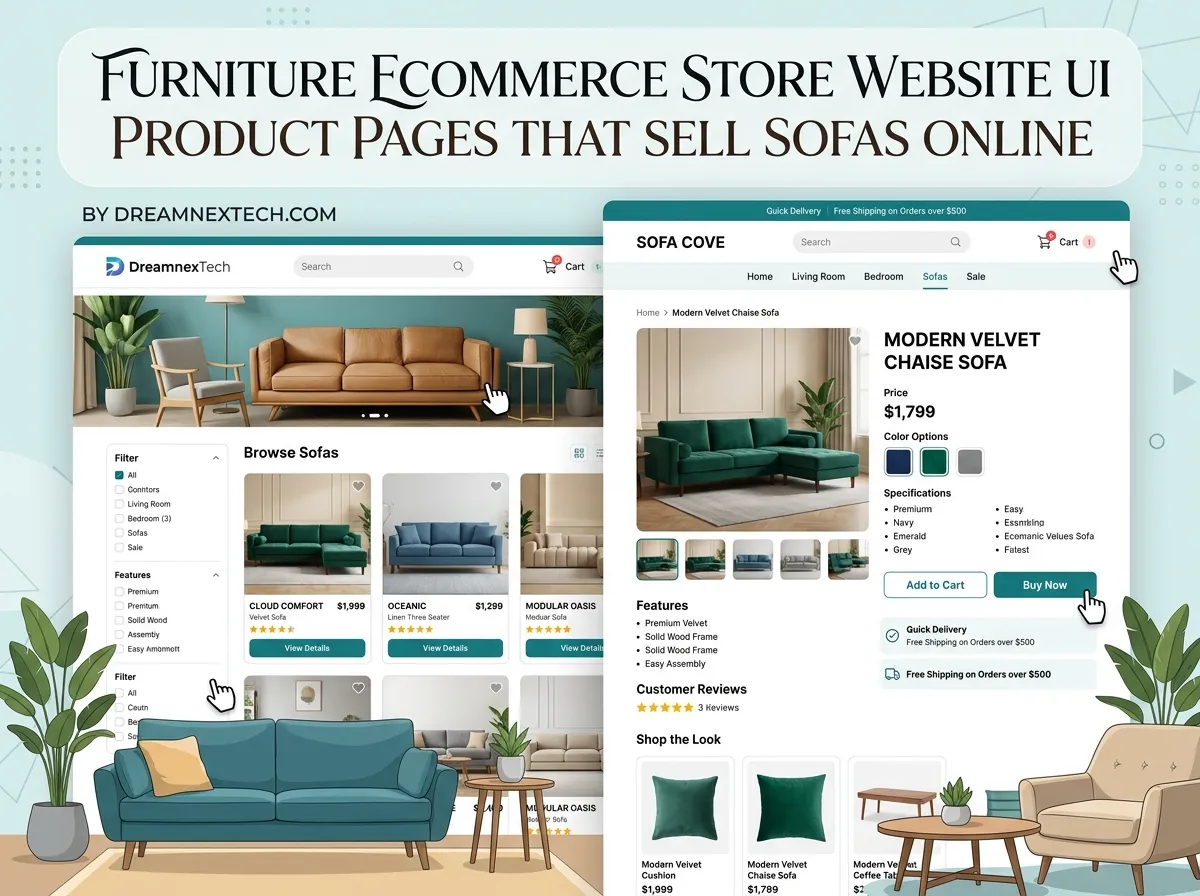
A design system, not a set of page pictures: colour and type tokens, spacing scale, and documented components — product card, gallery, swatch selector, filter panel, delivery estimator, review block, store locator, booking form. Mobile designed first, because that is where most of your traffic lives.
4. Front-End Development
Production-grade markup, semantic and accessible, with performance budgets enforced from the first commit. Responsive across every real breakpoint, not just three. Tested on actual devices, not only in a browser resizer.
5. Commerce and CMS Integration
Product data model built for variants and configurable options. Inventory sync. Payment gateways and financing providers. Delivery logic by postcode. A CMS your merchandising team can operate independently. also check furniture website development services.
6. Local Layer
Showroom pages with real content. Store locator with live availability. Appointment booking. LocalBusiness structured data. City pages that earn their rankings rather than duplicating each other.
7. Launch and Optimisation
Redirect mapping so you keep your existing SEO equity. Full analytics and event tracking. Then ongoing work: heatmaps, funnel analysis, A/B testing, and iterative improvement. Launch is the midpoint of the project, not the end.
Hire Our Professional Services
Local Retailer vs. Online-First: Different Priorities
If you are primarily a local retailer with showrooms, weight the investment toward local SEO, showroom pages, appointment booking, in-store availability display, and click-to-call. Your website’s main job is filling the showroom. Ecommerce can be a secondary channel.
If you are primarily online, weight it toward product page depth, search and filtering, checkout optimisation, delivery logic, swatch ordering, and post-purchase communication. Every objection has to be resolved on screen because there is no salesperson to resolve it.
Most furniture retailers are both — and the site has to serve both without either channel undermining the other. That balance is a design decision, and it should be made explicitly during discovery rather than by accident.
What You Should Refuse to Accept
- A design presented without any performance discussion
- Location pages that differ only by city name
- A CMS that requires developer involvement for routine updates
- No redirect plan during a migration
- No analytics or event tracking at handover
- Stock photography passed off as your showroom
- A fixed scope with no post-launch optimisation phase
Any of these is a signal that you are buying a deliverable rather than an outcome.
Realistic Timelines and Budgets
A small local furniture retailer with one showroom and a modest catalogue: roughly six to eight weeks, with the bulk of effort in design, local SEO, and content.
A multi-location retailer with a few thousand SKUs: three to four months, with significant time in product data modelling and integrations.
A multi-city brand with complex inventory and financing: four to six months, plus an ongoing optimisation retainer.
Anyone quoting two weeks for a full furniture ecommerce build is quoting a template installation. That can be the right choice at a certain stage — but be clear that is what you are buying.
How to Judge the Result
Six months post-launch, these numbers should have moved: ecommerce conversion rate, mobile conversion specifically, average order value, appointment bookings, local pack rankings for your city terms, page load times, and the time it takes your own team to publish a new collection.
If those numbers have not moved, the redesign was cosmetic.
Professional furniture store website design services should be judged on business outcomes, not on how the homepage looks in a case study screenshot. Insist on that standard from whoever you hire — including us.
If your traffic is healthy and your sales are not, the diagnosis is usually straightforward and the fix is entirely achievable.