

Your website worked beautifully at 80 products. At 800, search got slow. At 3,000, adding a new collection takes your team a full day, filters return wrong results, and nobody is confident the stock numbers are accurate.
This is the most common failure in furniture ecommerce, and it is never a design failure. It is an architecture failure. The site was built for the catalogue you had, not the catalogue you were going to have.
Furniture ecommerce store website development that scales is a set of decisions made early — decisions that cost almost nothing at launch and cost a full rebuild if you skip them.

Hire Our Professional Services
Furniture Ecommerce Store Website Development
The Product Data Model Is the Whole Game
Furniture has the messiest product data in retail. A single sofa might have four sizes, thirty fabrics, three leg finishes, two configurations, and different stock levels per warehouse. That is potentially thousands of variant combinations for one product.
Get the model right:
Separate product from variant. The product carries shared content — description, care instructions, warranty, imagery of the base design. The variant carries SKU, price, stock, and option-specific images.
Treat options as structured attributes, not text. Fabric should be an entity with a name, a swatch image, a grade, a price modifier, and a durability rating. If it is stored as a text field, you will never be able to filter by it properly.
Store dimensions numerically. Width, depth, height, seat height, weight — each as a number with a unit. This makes “sofas under 200cm wide” a real filter instead of an impossible one.
Model bundles and rooms explicitly. Furniture sells in sets. A bundle should be a first-class object with its own pricing logic, not a hack.
Get this right and everything downstream — filters, search, feeds, recommendations — becomes straightforward. Get it wrong and every feature you add fights the data. Furniture design services.
Search and Filtering That Survive Growth
Native database search stops being viable somewhere around a thousand products. Move to a dedicated search engine early — Algolia, Meilisearch, Typesense, or Elasticsearch depending on budget and stack.
What you need it to do:
- Instant results as the shopper types, with product thumbnails in the dropdown
- Typo tolerance — “sofabed,” “sofa bed,” and “sofa-bed” must all work
- Synonym handling — “couch” and “sofa,” “wardrobe” and “closet”
- Faceted filtering with live result counts, so no filter combination returns an empty page unexpectedly
- Merchandising rules — pin promoted items, boost in-stock products, demote discontinued lines
Search is disproportionately valuable in furniture ecommerce. Visitors who use site search convert at multiples of those who only browse. Underinvesting here is expensive.
Inventory and Multi-Warehouse Logic
Once you have more than one stockroom, inventory becomes a design constraint, not just an operations one.
- Sync stock in near real time from your ERP or POS
- Show location-aware availability: “In stock at Lahore warehouse — delivery in 4 days”
- Handle backorders and pre-orders with honest, visible dates rather than hiding the product
- Reserve stock at cart or at checkout — pick one and make it consistent
- Handle discontinued products by redirecting to the closest live alternative instead of serving a 404 that wastes accumulated SEO value
Hire Our Professional Services
Performance at Catalogue Scale
Image weight is the defining performance challenge in furniture ecommerce. A 3,000-product catalogue with ten images each is 30,000 images to serve efficiently.
The non-negotiables:
- A CDN-backed image pipeline with automatic format negotiation (AVIF/WebP) and on-the-fly resizing
- Responsive
srcsetso mobile never downloads desktop-sized files - Lazy loading everywhere below the fold, with the LCP image explicitly preloaded
- Static generation or aggressive edge caching for category and product pages, with cache invalidation on stock or price change
- Bundle discipline — code-split by route, defer non-critical JavaScript, audit third-party scripts quarterly
Performance budgets should be enforced in CI. If a pull request pushes LCP past 2.5 seconds, it should fail before it reaches production.
A CMS Your Team Can Actually Operate
Scalable furniture ecommerce website development means your merchandising team never needs a developer to do their job. They should be able to:
- Add products and variants through a clear interface
- Build landing pages from pre-built components
- Reorder collections and set merchandising rules
- Schedule sales and update pricing in bulk
- Manage city pages, blog content, and buying guides
If your team is emailing a developer to change a banner, the build has failed regardless of how it looks.
Integrations That Have to Work
At scale, your website is one node in a system:
- ERP or inventory system for stock and pricing
- Payment gateways plus financing providers
- Delivery and logistics partners for live tracking
- Email and CRM for abandoned carts and post-purchase flows
- Product feeds for Google Shopping and Meta catalogues
- Analytics with full ecommerce event tracking
Build these as clean, documented integrations rather than one-off scripts. Every undocumented hack becomes a future outage.
Scaling the Front End Too
As the catalogue grows, so does interface complexity. A documented component library — product card, gallery, filter panel, swatch selector, delivery estimator, review block — keeps the site consistent and makes new pages cheap to build. Without one, every new page is a small redesign, and after two years the site looks like five different websites stitched together.
If you have existing designs or mockups that need translating into clean, production-grade markup, that is exactly what our PSD to HTML5 conversion service handles.
Build for the Catalogue You Want
The retailers who scale well are the ones who made these decisions before they needed them. Structured product data, real search infrastructure, a proper image pipeline, an operable CMS, and clean integrations — none of these are expensive at launch. All of them are expensive to retrofit.
If your current site is already showing strain, the honest answer is usually that the data model needs rebuilding first, and the interface second. That order matters.
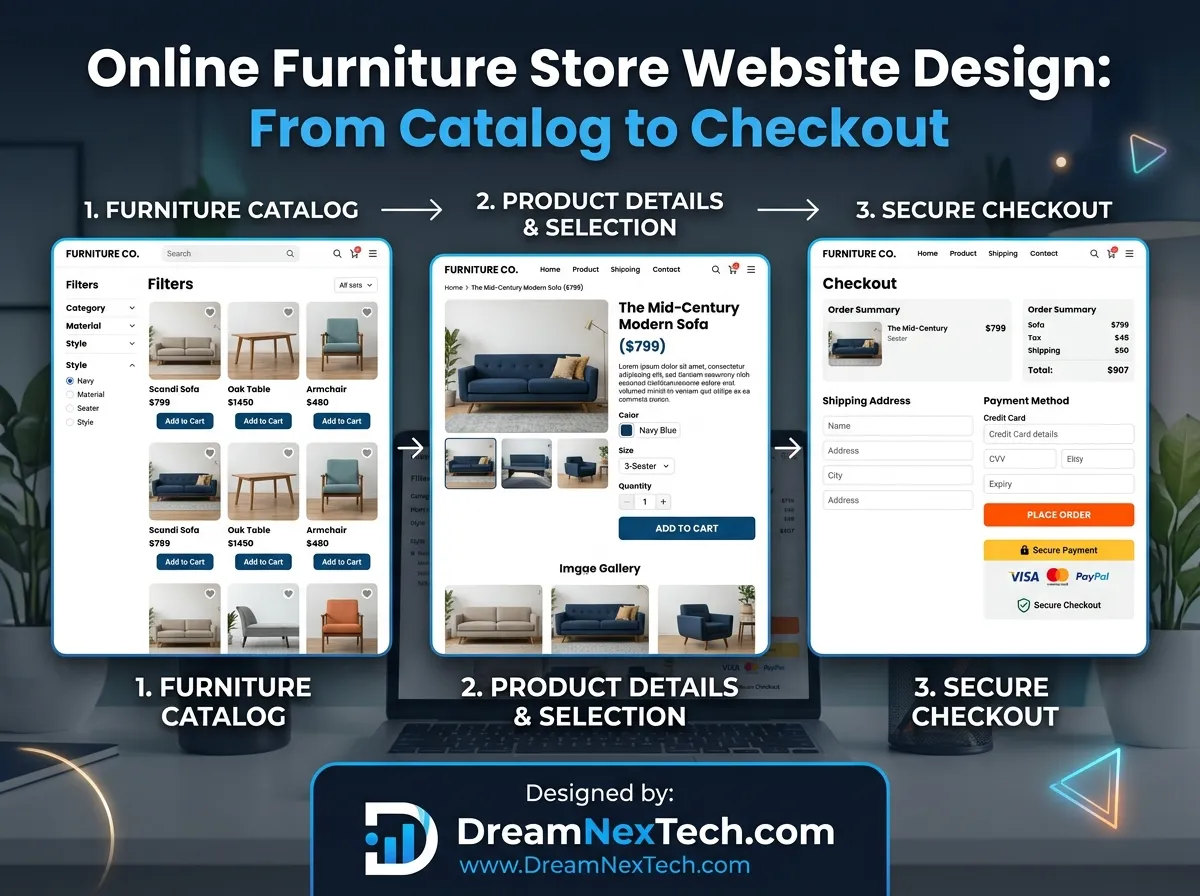
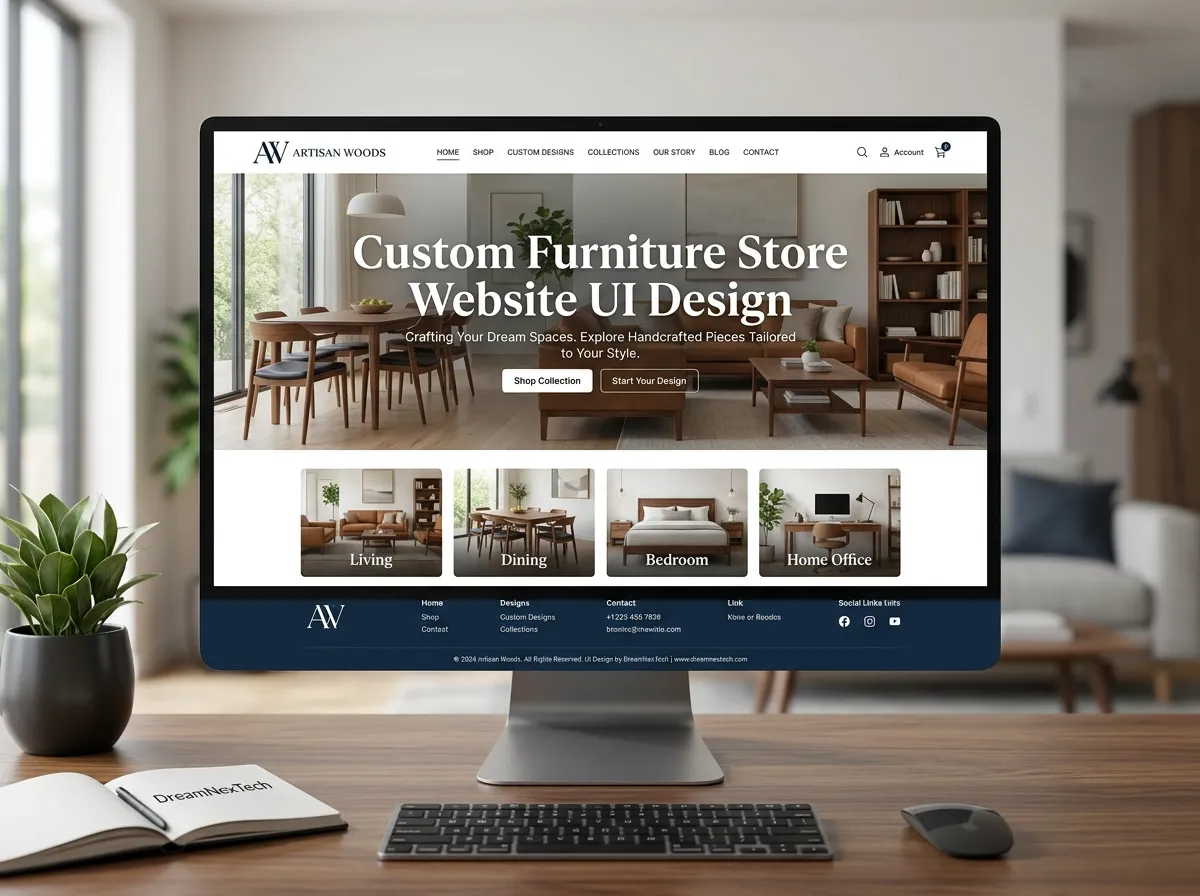



Custom Furniture Store Website UI Design
[…] Once that context exists, everything else becomes possible: accurate delivery estimates, branch-level stock, city-specific pricing and promotions, and the correct showroom surfaced everywhere. Check out Furniture store website. […]